Unmanned Pump Control, Choose 3S


 Language
Language
Shanghai 3S Global Company Limited

In an automatic pump control system, the controller relies on signals such as pressure, liquid level, and flow to determine when to start, stop, or switch pumps. Signal reliability directly affects the accuracy of these decisions and the stability of pump operation.
If an input signal is triggered incorrectly, lost, fluctuates, or becomes abnormal, the controller may not respond as intended even when the controller itself is functioning properly. For unattended or continuously operating pump systems, stable and accurate signal input is therefore a key foundation of reliable automatic control.
Automatic pump control is not simply about running a pump at fixed intervals. The controller continuously evaluates operating conditions based on signals from the field.
For example:
Water supply systems may use pressure changes to determine when to start or stop a pump.
Drainage systems may rely on liquid-level changes to control pump operation.
All of these control actions depend on reliable input signals.
The process can be simplified as: Field Condition → Signal Detection → Controller Decision → Pump Action
An abnormality at any stage can affect the final control result.
Poor signal reliability does not necessarily mean that the controller has failed. More often, the controller receives a signal that does not accurately represent the actual operating condition.
False Triggering
Electrical interference or unstable detection may cause an incorrect start or stop signal, resulting in unnecessary pump operation.
Frequent starting and stopping can affect system stability and increase the number of operating cycles of the motor and related electrical components.
Signal Loss
If a critical pressure or liquid-level signal is suddenly interrupted, the controller loses important information about the field condition.
Without appropriate signal-loss detection or protection logic, the pump control system may not respond as expected.
Signal Fluctuation
For continuous analog signals, such as 4–20 mA pressure or level signals, interference can cause the input value to fluctuate.
If control thresholds are highly sensitive, these fluctuations may lead to repeated or unstable control actions.
Mismatch Between Signal and Actual Condition
A more subtle problem occurs when a signal appears normal but no longer accurately represents the actual field condition.
For example, an unsuitable sensor location, incorrect installation, or poor wiring may cause the controller to make a correct decision based on incorrect information.
This means that correct control logic does not necessarily guarantee the correct result. The accuracy of the input signal matters as well.
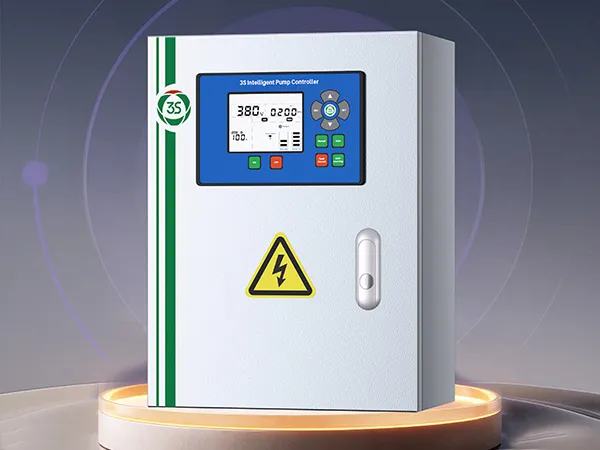
Automatic pump control systems may use different types of input signals, including digital and analog signals.
Digital signals are commonly used to indicate clear status changes, such as those from float switches, electrode probes, or pressure switches. When the water level or pressure reaches a defined condition, the signal changes state and the controller responds accordingly.
Analog signals, on the other hand, continuously represent a physical parameter, such as pressure or liquid level. The controller needs to determine not only whether the signal is present, but also whether the input value represents a reasonable operating condition.
Therefore, signal reliability is not simply about whether a signal is available. It also involves whether the signal is stable, within a reasonable range, and consistent with the actual field condition.
Improving signal reliability requires attention to the signal source, wiring, and controller.
First, the appropriate detection method should be selected for the application, and sensors, float switches, electrode probes, or pressure devices should be installed correctly.
Second, signal wiring and connections should be properly maintained, while electrical interference and poor contacts should be minimized.
For analog signals, the signal type and measurement range must also match the controller settings. For example, when using a 4–20 mA signal, the controller must be configured to correctly interpret the corresponding input range.
The controller should also provide appropriate signal fault detection and handling logic. When signal loss or abnormal input is detected, the pump control system can respond according to predefined strategies, such as issuing an alarm, stopping the pump, or activating another protection function.
Reliable automatic pump control system depends on more than the controller itself.
A typical automatic control process can be represented as: Field Detection → Signal Transmission → Controller Decision → Pump Action → Status Feedback
Signal reliability determines whether the controller receives trustworthy information from the field, while the controller uses that information to execute the appropriate control logic.
Therefore, signal reliability is a fundamental part of stable and accurate automatic pump control.
For pumps operating continuously, remotely, or without on-site personnel, it is important to evaluate the entire signal chain—including signal type, installation, wiring, and signal-fault handling—rather than focusing only on controller functions.
Why does signal reliability matter in automatic pump control systems?
Because every automatic control decision starts with field signals.
Reliable signals allow the controller to accurately identify conditions such as pressure and liquid level, reducing the impact of false triggering, signal loss, and abnormal fluctuations and helping the pump operate according to the intended control logic.
As pump systems become more automated and require less manual intervention, reliable signal input becomes not only a foundation for accurate control, but also an essential part of stable automatic operation.
 English
 Español
 русский язык
 Français
 اللغة العربية