Unmanned Pump Control, Choose 3S


 Language
Language
Shanghai 3S Global Company Limited

For a three-phase water pump control system, motor rated current is an important reference for monitoring the pump’s operating condition. A controller can compare the actual operating current with the rated current to identify abnormal conditions such as overload.
Traditionally, the rated current is entered manually based on the motor nameplate. However, manual settings can be affected by parameter reading, data entry, and commissioning errors.
That is why some water pump controllers provide an automatic rated current learning function. Under specified normal operating conditions, the controller measures the pump’s actual operating current and establishes an operating current reference for the system.
So, why is automatic rated current learning important for a water pump controller?
Motor rated current is an important electrical parameter that represents the current a motor is designed to draw under its rated operating conditions.
For a water pump controller, rated current is more than just a parameter that needs to be entered. It can also serve as an important reference for motor monitoring and protection.
During normal pump operation, the controller continuously monitors the actual operating current and compares it with the configured rated current.
If the operating current remains significantly above the expected level, it may indicate an increased load or an abnormal condition involving the pump or motor. The controller can then respond according to its preset protection logic.
Therefore, an appropriate rated current setting is important for the controller to evaluate the motor’s operating condition correctly.
Manual rated current settings are practical, but they require accurate parameter reading and input during installation and commissioning.
The motor nameplate provides an important reference, but the current drawn by a pump during actual operation can also be affected by factors such as pump load, water supply conditions, system resistance, and installation conditions.
In addition, manual configuration can introduce errors during field commissioning.
If the configured value differs significantly from the actual operating condition, it can affect the controller’s protection response:
Setting too low → Normal operation may trigger overload protection more easily
Setting too high → Abnormal current may take longer to reach the protection threshold
This makes establishing an appropriate current reference an important part of water pump controller design.
The purpose of automatic rated current learning is not to have the controller “guess” the motor parameters. Instead, under specified learning conditions, the controller uses actual operating data to establish a current reference.
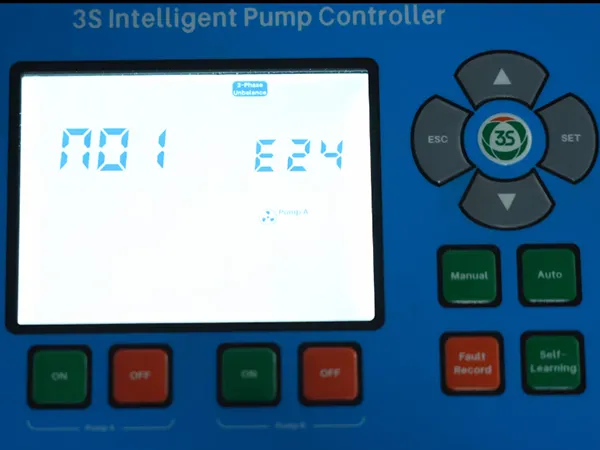
The basic process can be understood as: Confirm learning conditions → Start the pump → Monitor operating current → Obtain stable operating data → Establish the current reference
During the learning process, the water pump controller measures the pump’s actual current under normal operating conditions and determines the reference according to its predefined learning logic.
This means automatic learning is not simply a matter of recording the current at pump startup. The controller needs to obtain meaningful data from an appropriate and stable operating condition.
Therefore, the value of automatic learning lies not simply in automation, but in establishing a current reference based on the pump’s actual operating condition.
1. Reduce Manual Setting Errors
Automatic learning can reduce the need to manually read and enter parameters, helping minimize errors during installation and commissioning.
For water pump systems that require repeated installation or commissioning, this can also simplify the setup process.
2. Establish a More Relevant Operating Reference
A water pump does not operate independently of the system.
Actual operating current can vary with pump load, piping conditions, system resistance, and other operating factors. Establishing a reference based on actual operation can provide the controller with a more relevant basis for monitoring the current operating condition.
3. Provide a Reference for Protection
The current reference established through automatic learning can be used as an important basis for current monitoring and related protection functions.
When the actual operating current deviates from the normal reference and reaches the relevant protection criteria, the controller can take the corresponding action according to its protection logic.
Therefore, automatic learning is not an isolated function. It is closely connected with operating-current monitoring and motor protection.
The quality of the learned reference depends on the operating condition during the learning process.
If the pump is already operating abnormally or the system load is significantly different from normal, the measured current may not represent the pump’s normal operating condition.
Before performing automatic learning, it is therefore important to confirm that:
A current reference established under normal operating conditions is more meaningful for subsequent monitoring and protection.
For a water pump controller, rated current is not simply a number that needs to be entered.
It connects three important aspects of pump control: motor parameters, actual operating conditions, and protection logic.
Manual configuration establishes a protection reference based on known motor parameters. Automatic learning goes one step further by using actual pump operating data to establish a reference that reflects the field operating condition.
Therefore, the purpose of automatic rated current learning is not simply to eliminate one manual setting. It is to help the controller establish a more appropriate current reference based on actual operation, providing a foundation for subsequent operating-current monitoring and motor protection.
For water pump systems designed for reliable long-term operation, establishing an appropriate current reference is an important starting point for accurate condition monitoring and protection.
 English
 Español
 русский язык
 Français
 اللغة العربية