Unmanned Pump Control, Choose 3S


 Language
Language
Shanghai 3S Global Company Limited

When a three-phase water pump is running, an abnormality in any one phase can disrupt the motor’s normal operating condition. A smart pump controller typically detects three-phase electrical parameters, such as voltage and current, and evaluates their balance against preset thresholds and time delays to determine whether a phase-loss fault has occurred. Once the fault is confirmed, the controller can stop the pump and trigger a fault indication to prevent continued operation under abnormal power conditions.
Three-phase phase loss occurs when one phase of a three-phase power supply is disconnected or becomes severely abnormal, preventing the motor from receiving a normal three-phase supply.
In practical applications, phase loss can result from various issues, including:
For a three-phase induction motor, phase loss disrupts the normal balance of the electrical system and can cause significant voltage or current imbalance. If the pump continues to operate under these conditions, the motor may experience abnormal current and increased temperature, affecting its normal operation.
This is why a smart pump controller needs to continuously monitor the three-phase operating condition.
Detecting phase loss is not simply a matter of checking whether one phase has power. Instead, the smart pump controller monitors and compares three-phase electrical parameters to determine whether the power supply remains within the conditions required for normal operation.
Common detection methods include three-phase voltage monitoring and three-phase current monitoring.
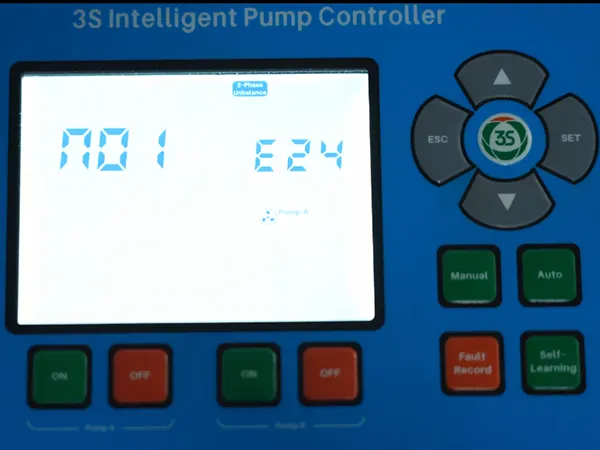
1. Monitoring Three-Phase Voltage
A controller can monitor the input voltage of each phase and evaluate the relationship between the three phases.
When one phase is disconnected or becomes severely abnormal, the three-phase voltage condition changes significantly. If the deviation exceeds the controller’s preset criteria, the system can identify it as a phase-loss or voltage-related fault.
However, phase loss does not necessarily mean that the voltage on the affected phase will drop completely to zero.
When a motor is already running, electrical effects within the motor can cause voltage to remain present on the affected phase. Therefore, simply checking whether one phase has zero voltage may not reliably identify every phase-loss condition during operation.
2. Monitoring Three-Phase Current
Another common approach is to monitor the motor’s three-phase current during operation.
Under normal conditions, the three phase currents should remain relatively balanced and correspond to the motor’s load. When phase loss occurs, the relationship between the three phase currents changes significantly.
By comparing the current on each phase, the smart pump controller can identify excessive current imbalance or a phase-loss condition. If the deviation reaches the preset protection criteria and persists for a defined period, the controller can confirm the fault.
This means that for motor protection, the relationship between the three phase currents can provide more useful information than simply checking whether one phase is present.
Electrical parameters can experience short-term fluctuations while a pump is operating. If the smart pump controller stopped the pump every time a temporary abnormality occurred, unnecessary shutdowns could result.
For this reason, phase-loss protection generally considers not only a detection threshold, but also an operating time delay.
The basic logic can be understood as: Detect abnormality → Compare with threshold → Confirm persistence → Trigger phase-loss protection
Only when the abnormal condition meets the defined criteria and persists for the required period does the controller confirm the fault.
This combination of threshold and time delay helps distinguish temporary fluctuations from persistent abnormalities and allows the protection response to better match actual operating conditions.
Once the smart pump controller confirms that the phase-loss condition meets its protection criteria, it can take the corresponding protective action according to its control logic, such as stopping the pump and displaying or recording the relevant fault information.
At this point, troubleshooting should not focus only on the pump. The entire three-phase power circuit should be checked, including: Power Supply → Circuit Breaker → Contactor → Wiring Terminals → Pump Motor
A phase-loss fault can occur at any point in this circuit. Identifying and correcting the actual cause is therefore essential before returning the pump to normal operation.
From a control perspective, three-phase phase-loss protection can be summarized in three steps:
Detection: Continuously monitor three-phase electrical parameters such as voltage and current.
Evaluation: Compare the measured values with preset protection criteria and use a time delay to confirm whether the abnormality is persistent.
Response: Once phase loss is confirmed, stop the pump and indicate the fault to prevent continued operation under abnormal power conditions.
Therefore, detecting three-phase phase loss is not simply about determining whether one phase has lost power. It is about evaluating whether the three-phase power condition still meets the requirements for normal motor operation.
For three-phase water pump systems, appropriate phase-loss detection and protection logic can help smart pump controllers respond to power abnormalities in a timely manner and provide essential protection for reliable pump operation.
 English
 Español
 русский язык
 Français
 اللغة العربية